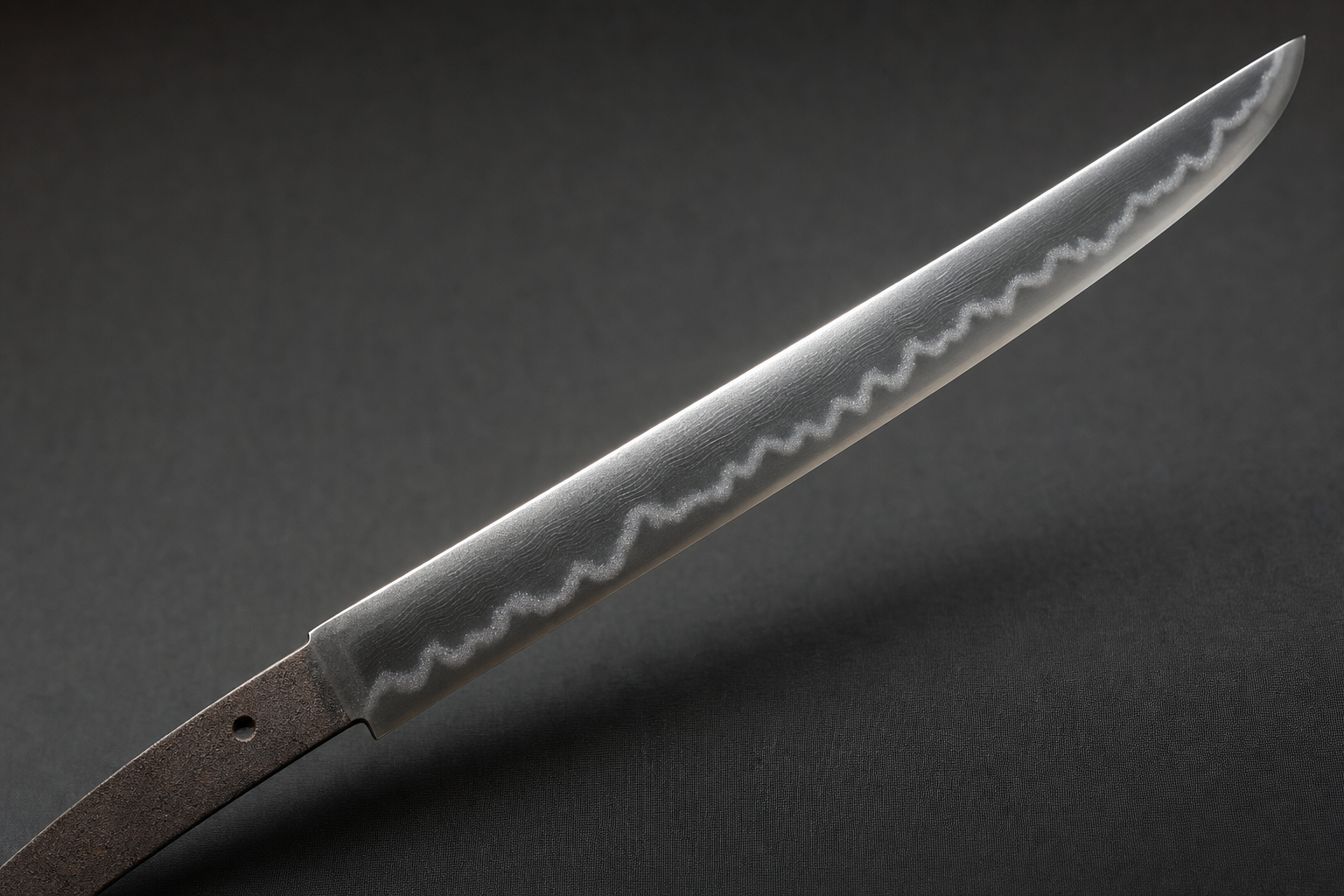
Goro Nyudo Masamune worked in Kamakura around the late 13th and early 14th century. He is considered by broad scholarly and collector consensus to be the greatest Japanese swordsmith who ever lived. None of his surviving blades bears his signature.
The Attribution Problem
The absence of signatures on Masamune blades is not unusual for his era — many early Koto smiths did not sign their work, or signed the tang (nakago) in ways that were later removed when blades were shortened. What makes the Masamune attribution unusual is that approximately 19 blades designated as National Treasures or Important Cultural Properties carry his attribution based entirely on tradition, documentary reference, and connoisseurship — not physical signatures. The chain of custody documentation for the most significant examples traces back centuries, lending credibility to the attributions, but the lack of direct physical evidence makes Masamune scholarship permanently dependent on interpretive judgment.
The Nie-Deki Hamon
What can be said objectively about the blades attributed to Masamune is that they share a distinctive hamon character: the nie-deki style, in which bright martensite crystals (nie) are densely distributed in the temper zone, creating a texture that observers describe as stars scattered across a dark sky, or as a surface alive with internal light. This effect results from the specific carbon content, quench temperature, and cooling rate that Masamune achieved through empirically refined technique. It requires exquisitely calibrated control of temperatures that Masamune had no thermometer to measure — only the color and behavior of steel in the fire.
The Honjo Masamune — considered by many the finest example of his work and Japan’s greatest sword — was surrendered to American occupation authorities in 1945 and has never been located. Its loss is one of the significant cultural heritage losses of the postwar period.
The Ten Famous Disciples
The tradition records ten great students of Masamune — the “Masamune Juttetsu” (Ten Famous Disciples) — who spread his technical influence across Japan. Among them: Sadamune (said to be his son or adopted son), Yukimitsu, Norishige (known for distinctive matsukawa-hada, pine bark-grain surface texture), and Go Yoshihiro, whose short career produced blades of extraordinary technical sophistication. Through these students, the Soshu tradition’s influence on hamon design and steel quality spread to become the dominant reference point for Japanese sword excellence.