Maintaining a Japanese blade correctly is not complicated, but it requires consistency. Carbon steel — the material in all traditional nihonto and most quality production katana — will rust within hours if left damp. The care ritual is the sword’s practical survival condition.
What You Need
Traditional Japanese sword care requires a handful of materials, none expensive:
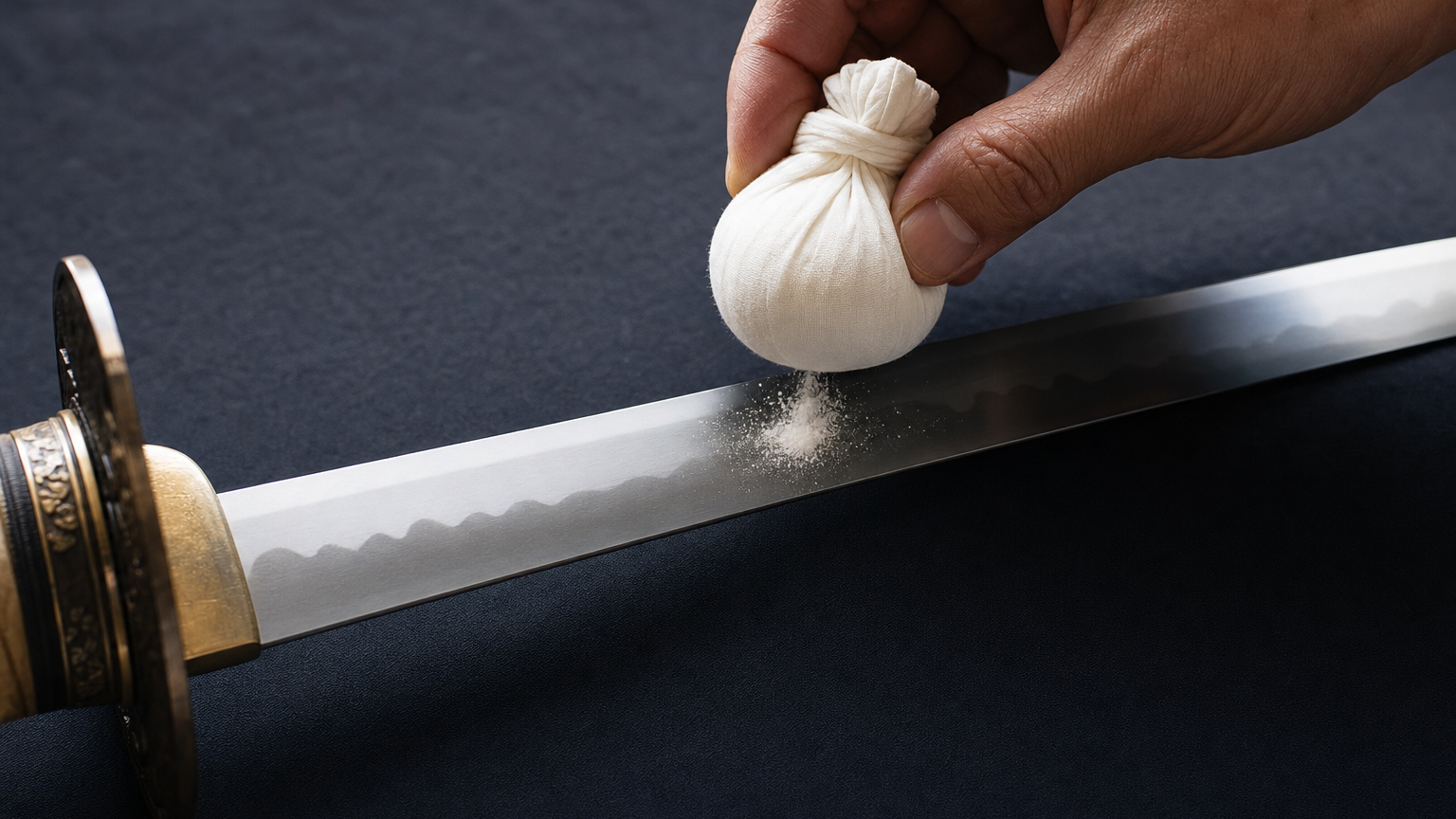
- Uchiko powder ball: A small silken ball filled with fine polishing powder. Used in a light tapping motion to lift old oil from the blade surface before re-oiling. Do not press hard — the powder is mildly abrasive and is used only to break down oil film, not to polish the steel.
- Nuguigami (wiping paper): Soft, lint-free Japanese paper (or a substitute soft cloth) for removing oil and powder residue. Traditional nuguigami is made from specific washi paper. Clean chamois or lint-free microfiber substitutes adequately.
- Choji oil or equivalent: Camellia oil (tsubaki oil) is the traditional Japanese choice for blade preservation. Light mineral oil or food-grade silicone oil work comparably. The oil creates a thin protective layer that prevents atmospheric moisture from reaching the steel. Do not use cooking vegetable oils — they oxidize and leave a sticky residue over time.
- A soft cloth or mekugi-nuki (peg punch): For removing the mekugi (bamboo peg that secures the handle to the tang) if handle removal is needed for deep cleaning.
The Care Sequence
Full care should be performed after any handling and periodically on stored swords (every 3-6 months in normal storage conditions, more frequently in humid environments):
- Draw the blade carefully. Always move the blade, not your hand along the blade edge.
- Hold the blade with the edge away from you. Support the spine on a padded rest or hold at the handle with the blade horizontal.
- Lightly tap the uchiko ball along the flat of the blade from base to tip. Three or four light taps per section. The powder breaks down old oil.
- Wipe the blade from base to tip with a single smooth motion using nuguigami. Fold the paper after each wipe to expose a clean surface. Repeat until no discoloration appears on the paper.
- Apply a small amount of choji oil to a fresh piece of nuguigami. Wipe from base to tip with light, even pressure, leaving a very thin oil film across the entire blade surface including the tip area.
- Wipe once more lightly to remove any excess — the oil layer should be invisible, not wet-looking.
- Return the blade to its scabbard in a controlled motion. The saya (scabbard) should receive the blade with the edge aligned to the saya’s mouth.
What to Avoid
Never use metal polish, Brasso, or automotive metal polishes on a nihonto. These products are abrasive compounds that will remove the blade’s polish and the hamon‘s surface activity. If a blade develops significant rust, take it to a professional sword polisher (togishi) — amateur rust removal with abrasives almost always damages the blade more than the rust did.
Never store a blade in a leather scabbard for extended periods — leather traps moisture against the steel. The traditional wooden saya is designed to allow slight air exchange while protecting the blade from physical damage. If a blade must be stored in a leather sheath temporarily, remove it and clean and oil immediately on retrieval.
Avoid touching the blade surface with bare hands when possible. Skin oils accelerate rust and leave fingerprint marks that etch into the surface. Handle at the handle, wrapped spine, or with clean gloves when examining the blade.