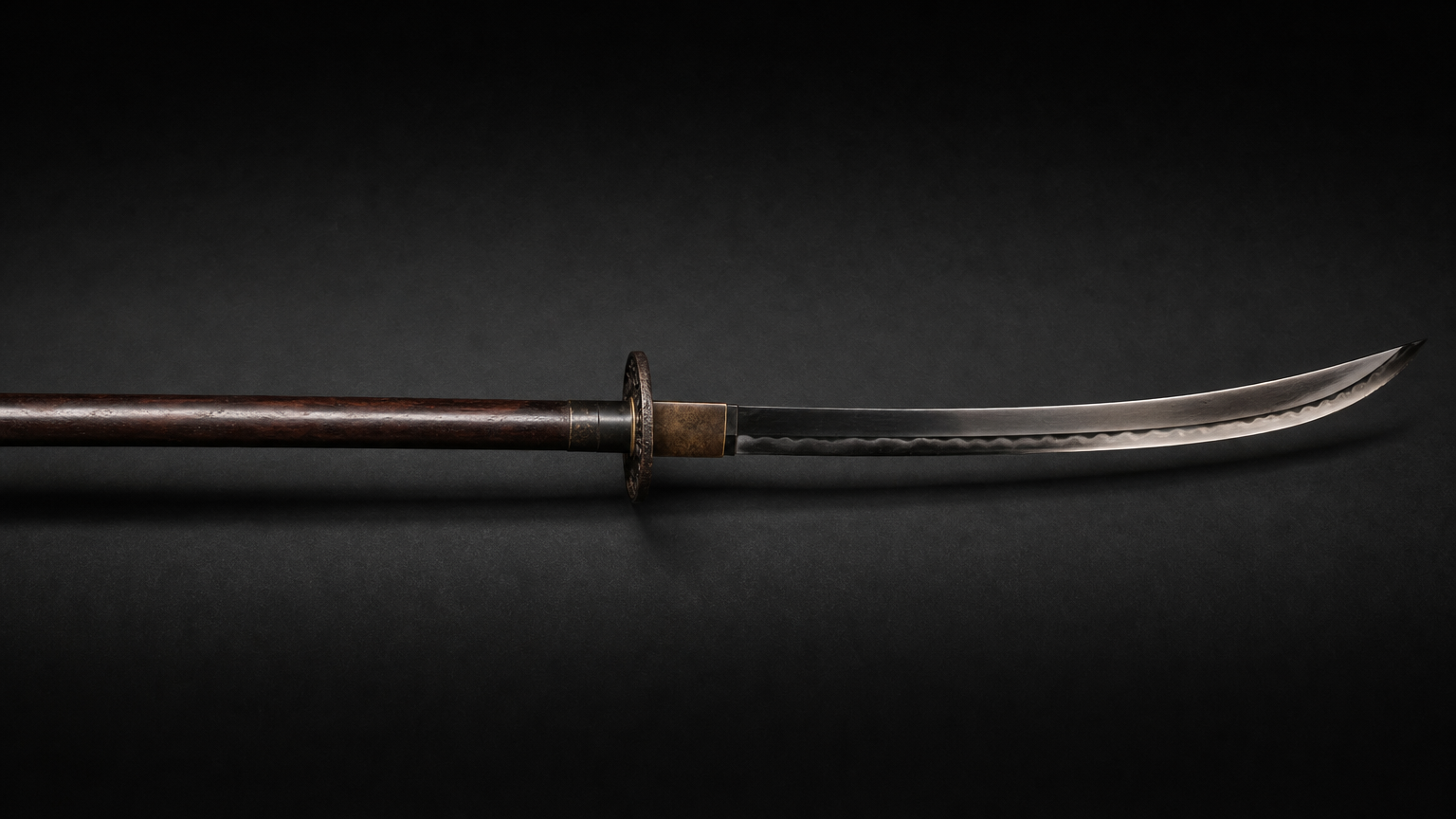
The Japanese naginata — a curved blade mounted on a long wooden pole — is one of the most frequently misunderstood weapons in Japanese martial arts. Western audiences often conflate it with Chinese glaive weapons or European halberds, but the naginata occupies a distinct tactical and cultural position in Japanese history.
Description and Construction
A naginata consists of a single-edge curved blade (the nagasa, typically 30–60 cm) mounted on a pole (the e, typically 120–180 cm) via a socket attachment (the nakago, the blade’s tang fitting into the pole). The total length gives a reach advantage over sword-armed opponents and against cavalry. The blade’s curvature allows both slashing and thrusting attacks in the same swing.
Traditional naginata blades are made from the same steel traditions as katana — tamahagane differentially hardened — and are considered nihonto for classification purposes. Significant historical naginata blades survive in museum collections and are subject to the same scholarship and certification systems as sword-length blades. Many historical naginata were later shortened and remounted as shorter weapons (a process called suriage for swords) — a practice that means identifying an original naginata blade versus a shortened one requires careful examination of the nakago and blade geometry.
Tactical Role
Naginata were effective against cavalry — the long reach allowed a foot soldier to attack a rider’s horse or legs before the rider’s sword could reach. They also performed well in the crowded battles of the Heian and Kamakura periods, where the sweep of a naginata in a formation could clear space differently from a sword. Their use by Buddhist warrior monks (sohei) at temples like Enryaku-ji on Mount Hiei is well-documented — the combination of religious organization, military training, and naginata-armed monks made the major temple complexes political and military forces in their own right during the Heian period.
Women and the Naginata
By the Edo period, the naginata had become associated particularly with women of the samurai class. As the tactical situation of open infantry warfare receded and the sword became a male-status weapon, the naginata was taught to samurai women as a defensive weapon for household protection when male family members were away. The imagery of the onna-bugeisha — the armed samurai woman — is often associated with naginata.
This historical association gave the naginata a continuing cultural identity into the modern period. Naginata training today is primarily practiced by women in Japan — a distinct inversion of most other martial arts demographics. The All Japan Naginata Federation oversees sport naginata (atarashii naginata), a competitive form using padded naginata against armored opponents. Traditional forms (koryu naginata-jutsu) are also practiced within older martial arts traditions that preserved them.
Modern Practice
Atarashii naginata (modern sport naginata) is practiced at all levels in Japan and internationally, with Japan fielding competitive teams in the World Naginata Championships. The art’s association with women continues — approximately 95% of naginata practitioners in Japan are female. This makes it one of the few surviving traditional Japanese martial arts where women hold the primary position in the practitioner community rather than being a minority.